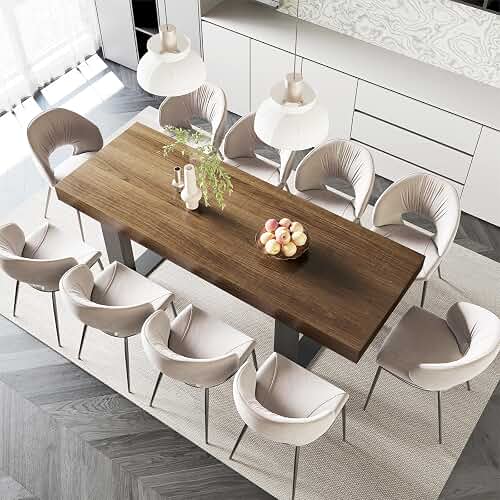
How the tables below compare on the numbers that matter
Only specs stated by the manufacturer are listed. "Not stated" means exactly that — go measure it on the listing page before you commit.
| Product | Stated size | Seats | Height | Weight capacity | Price |
|---|---|---|---|---|---|
| 71-87 Inch Extendable Dining Room Table, Rustic Wooden Kitchen Table 6-10 | 70.9" extending to 86.6" long; width not stated | 8–10 | Not stated | 300 lbs | Check price on Amazon |
| FDW | 5-Piece Dining Table Set | Black | Glass Kitchen Table | Not stated | 4 | Not stated | Not stated | $108.99 |
| 42" Round Dining Table for 4, Farmhouse Kitchen Table with Storage… | 42" diameter | 2–4 | Not stated | Not stated | Check price on Amazon |
| LITTLE TREE Dining Table for 6 People, Wooden Dining Table… | Not stated; 1.18" thick top | 6 | Not stated | Not stated | Check price on Amazon |
| Signature Design by Ashley Ralene Extendable Dining Table | 42 W x 60.13 D x 30.25 H; 78.13 D with 18" leaf | 6–8 | 30.25" | Not stated | Check price on Amazon |
| GarveeHome Industrial Dining Table for 6-8, 70.87" | 70.87" L x 35.43" W x 30" H | 6–8 | 30" | 350 lbs | Check price on Amazon |
Quick answer: Measure your room's length and width in inches, then subtract 72 inches from each dimension — that's 36 inches of walking clearance on every side — and what's left is the largest table footprint that will actually work. Allow about 24 inches of table edge per seated person, and check the table's stated height (30 inches is standard dining height) plus the swing space your chairs need. If a table's listing doesn't state its dimensions, that's your cue to ask before you buy, not after.
The three numbers you need
1. Room dimensions. Wall to wall, in inches, both directions. Note anything that eats into the space: a radiator, a door that swings in, a sideboard you're keeping.
Finding the right how to measure dining room for table comes down to matching the features to how you will actually use it.
2. Clearance. 36 inches from table edge to the nearest wall or furniture is the working minimum — enough to pull a chair out and slide into it. 42 to 48 inches is comfortable, and it's what you want on any side people walk past while others are seated. So: room length minus 72 inches = maximum table length. Room width minus 72 = maximum table width.
A 12 x 10 ft room is 144 x 120 inches. Minus 72 each way, your ceiling is roughly 72 x 48 inches. A 10 x 10 room drops you to about 48 x 48 — round territory.
3. Seats. Plan 24 inches of edge per person (22 is tight, 26 is generous). A 72-inch rectangle gives three seats per long side plus one at each end if the width allows. Table width of 36 to 40 inches lets you put serving dishes down the middle; under 36 inches, food and elbows compete.
Then tape it out. Painter's tape on the floor in the exact footprint, chairs set where they'd go, and walk the room. Ten minutes of tape beats a return shipment of a 70-pound tabletop.
The measuring-first pick: an extendable table
If your measurements land in that awkward zone — enough room for six most days, not enough to leave a ten-seater parked there year-round — an extendable table is the honest answer. The 71-87 Inch Extendable Dining Room Table, Rustic Wooden Kitchen Table 6-10 goes from 70.9 to 86.6 inches, which per the 24-inch-per-seat rule is the difference between comfortably seating eight and stretching to ten. It's built from engineered MDF on a widened U-shaped base rated to 300 lbs, and the manufacturer describes a zero-gap joint with silent rails so the length adjusts without repositioning the legs — worth knowing, because some extension mechanisms require you to move a leg assembly, which changes where knees land.
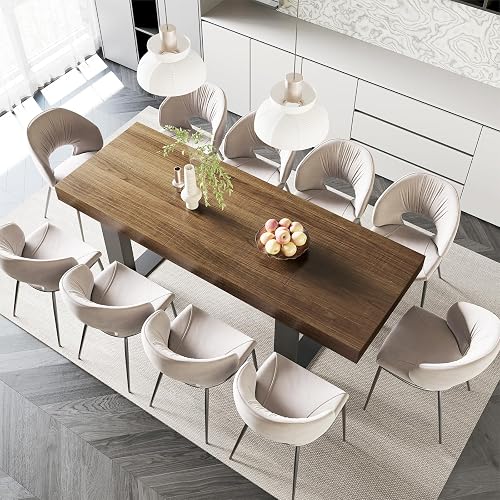
Measure for the extended length. A table you can't open because the wall is 12 inches away is just a fixed table with extra hardware.
Who this suits
Households that host. If your everyday number is four to six but Thanksgiving is ten, and your room measures at least 143 inches (86.6 + 56) in the direction the table extends, this shape of table solves a real problem. It also suits anyone whose room passes the closed-length test but fails the open-length test only on one axis — you can often orient the extension toward the open side of the room rather than toward a wall.
Who should skip it
Skip an 86-inch extendable if your room's longest usable run is under about 143 inches — you'll never open it. Skip it if you want a stone, solid-hardwood or glass surface, since this one is engineered MDF. Skip it if you need a stated tabletop width for your placemat-and-platter math: the width isn't given in the product data, so if a specific width is load-bearing for your layout, confirm it on the listing first. And skip any extendable if nobody in your house will actually bother extending it — a fixed table of the right length is simpler.
Honest trade-offs
Extendables buy flexibility and pay for it in complexity: more moving parts, more places to develop a wobble, and a seam down the middle of the top. Engineered MDF at this price point is dimensionally stable and easy to clean, but it isn't refinishable the way solid wood is — a deep gouge is permanent. A 300 lb capacity is plenty for food and elbows and not an invitation for someone to stand on it. And the "seats 8–10" figure assumes the tighter end of per-person spacing; at a generous 26 inches per seat, 86.6 inches is realistically eight.
What to check on the listing before you buy
- Current price and finish variant. Prices and available colors move; the figures here reflect the product data provided, not what you'll see today.
- The dimensions on the live listing, especially width and height where they're marked "Not stated" above. Confirm the tabletop width and the apron-to-floor clearance so your chairs fit under it.
- Whether chairs are included. Several of these are table-only.
- Warranty and return window, and who pays return shipping on a heavy item — that's the expensive surprise.
- Owner reviews and posted customer photos, read yourself, for assembly difficulty and wobble complaints. Photos in a real room are the best size sanity-check you'll get.
Consider instead if…
FDW | 5-Piece Dining Table Set | Black | Glass Kitchen Table — consider instead if…
…your measurements came back small and you need chairs too. This $108.99 set pairs a rectangular glass tabletop with four faux-leather cushioned chairs designed to slide fully under the table when not in use — which matters when your clearance math is tight, because a tucked chair reclaims its own depth. Dimensions aren't stated, so measure from the listing.
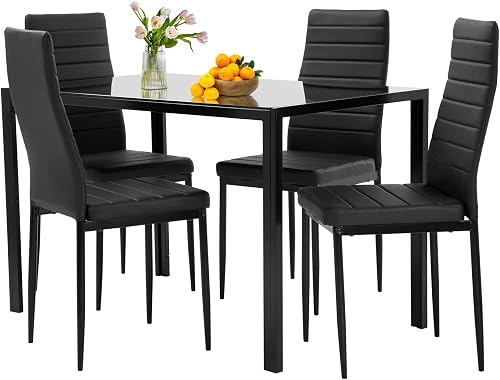
FDW | 5-Piece Dining Table Set | Black | Glass Kitchen Table
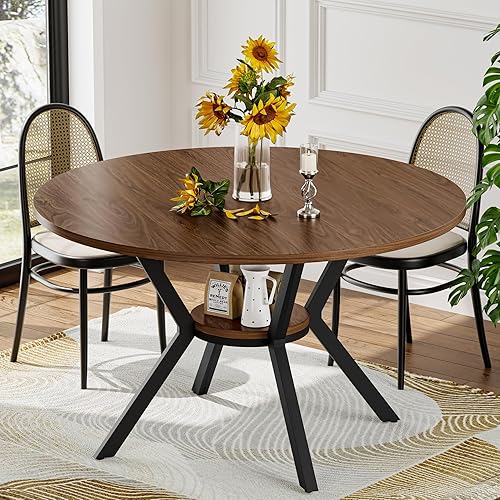
42" Round Dining Table for 4, Farmhouse Kitchen Table with Storage, Space Saving Circle Dinner Table, Rustic Wood Kitchen & Dining Room Tables with Metal Legs for Home, Apartment, Office, Restaurant — consider instead if…
…your room is roughly square or under about 10 x 10 feet. A 42-inch circle seats two to four, has no corners to bruise hips in a tight walkway, and the pedestal-style X base means chair placement isn't dictated by leg position. It adds a lower storage shelf and 50×25mm steel legs. Table only — chairs aren't included.
LITTLE TREE Dining Table for 6 People, Wooden Dining Table, Rectangle Table with Heavy Duty Legs, Modern Dining Table for Kitchen, Dining Room, Light Brown — consider instead if…
…you measured once, six seats fits, and you'd rather not own a mechanism. A fixed six-seater with a 1.18-inch-thick scratch-resistant top and heavy-duty legs shaped so they don't block chair storage. Dimensions aren't stated in the product data, so pull them off the listing before you tape out your floor.
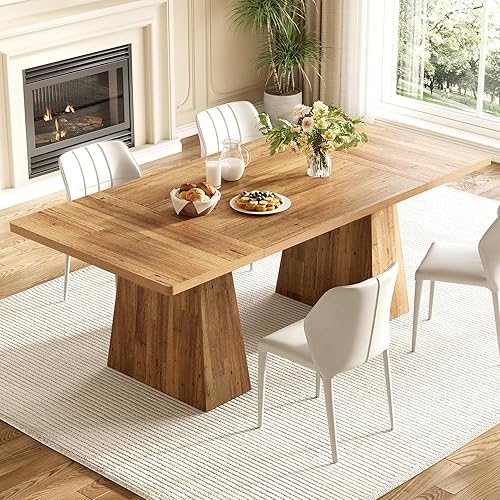
Signature Design by Ashley Ralene Extendable Dining Table, With Butterfly Leaf Seats 6-8, Wood Dining Room Table for Family Meals, Burnished Brown 42 x 60-78 Inch — consider instead if…
…you want every dimension published before you buy. It's 42 W x 60.13 D x 30.25 H closed and 78.13 D with the 18-inch butterfly leaf in — which is the rare listing that lets you do the full clearance calculation without guessing. The leaf is self-storing, so there's no closet hunt. Built from veneers, wood and engineered wood.
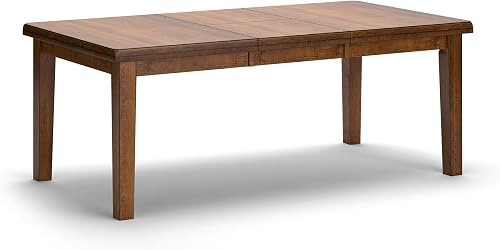
GarveeHome Industrial Dining Table for 6-8, 70.87" Heavy Duty Rectangular Kitchen Table with 2"×2" Metal Legs & Wood Top, Large Dining Table for Home Office, Dining (Brown, 71" Non-Extendable) — consider instead if…
…you have the length but want a fixed table with published width. 70.87 L x 35.43 W x 30 H, rated to 350 lbs on 2"×2" steel legs with a reinforced T-frame, and the 30-inch height is described as clearing adults up to 6 feet. That 35.43-inch width is on the right side of the 36-inch line for center-of-table serving. Seven finishes; chairs not included; assemble with a second person.
FAQ
How do I measure a table I already own? Length and width across the top at the widest points (include any overhang past the legs), then floor to tabletop for height. Also measure floor to the underside of the apron — that number, not the height, decides whether a chair or bench slides under.
How much clearance do I really need behind a chair? 36 inches minimum from table edge to wall. A chair pulled out to sit occupies roughly 20 inches; you need the rest to stand up and walk behind it. If it's a pure walkway with no seat behind it, 48 inches is the comfortable target.
What size table fits a 10 x 12 foot room? 120 x 144 inches minus 72 each way leaves about 48 x 72 inches — a 72-inch rectangle seating six, or a 48-inch round. If you'd rather have 42 inches of clearance, drop to roughly 60 x 36.
Does the delivery path count as measuring? Yes, and it's the step people skip. Measure your doorways, hallway turns and stair width, then compare against the shipping box dimensions on the listing. A flat-pack table that assembles in the room solves this; a preassembled top does not.
Related guides
- How to Match Dining Chairs to Your Table
- Best dining room furniture and tables - dining tables, dining chairs, bar stools, sideboards, kitchen islands, counter-height dining sets, china cabinets, bar carts, kitchen dining sets for Families
- Best dining room furniture and tables - dining tables, dining chairs, bar stools, sideboards, kitchen islands, counter-height dining sets, china cabinets, bar carts, kitchen dining sets with Past Challenges
Key Takeaways
- Choosing the right how to measure dining room for table means matching the key features to your specific needs and budget
- Read real customer reviews and check the return policy before you commit
- Compare value across models — the priciest option is not always the best fit