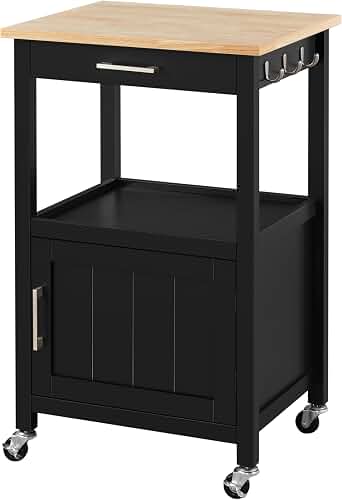
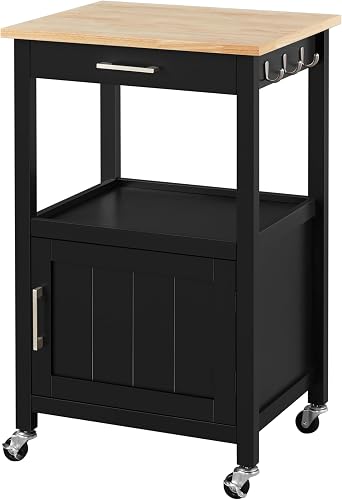
Quick answer: The Yaheetech Kitchen Island Cart with Storage, Rolling Kitchen Island on Wheels with 6 Side Hooks, Wood Top Microwave Cart with Drawer for Dining Room, Black is a small, mobile, budget-tier cart built to add a work surface and a bit of closed storage to a kitchen that has neither. At a listed $77.99 with a 138 lb total weight capacity, it is aimed squarely at renters, apartment kitchens, and anyone who wants a microwave off the counter — not at people who want a permanent butcher-block prep island. Read the spec table below before you fall in love with the photos, because capacity is where this one draws its line.
Specifications
| Spec | Detail |
|---|---|
| Brand | Yaheetech |
| Listed price | $77.99 |
| Color | Black |
| Countertop | Wood top |
| Total weight capacity | 138 lb |
| Casters | Four 360° swivel wheels, two lockable |
| Drawers | 1 |
| Cabinet | 1 |
| Open shelving | 2 open spaces |
| Side hooks | 6 |
| Countertop dimensions | Not stated |
| Overall dimensions | Not stated |
| Cabinet shelf adjustable | Not stated |
| Assembly required | Not stated |
| Warranty | Not stated |
Everything above comes from the manufacturer's listing. Anything marked "Not stated" is genuinely absent from the product data — don't assume it, check it.
Who this cart is for
This is a good fit if your problem is surface area and mobility, not bulk storage.
Finding the right yaheetech kitchen island cart review comes down to matching the features to how you will actually use it.
Concretely, it makes sense if:
- You rent. Four swivel casters mean it moves out with you and rearranges without tools. Two of the four lock, so it stops being a moving target while you chop.
- Your microwave is eating your counter. Yaheetech markets this as a microwave cart, and the 138 lb total capacity comfortably covers a countertop microwave plus what you'd stash below.
- You want hanging storage. Six side hooks are the sleeper feature here. Oven mitts, towels, tongs, a reusable bag — things that otherwise live in a drawer you have to open with wet hands.
- You have a narrow galley kitchen. Yaheetech describes this as compact while still fitting two open spaces, a drawer, a cabinet, and the hooks. That's a lot of storage types in a small footprint.
- Budget is a real constraint. At $77.99 listed, this is entry-level pricing for a cart with a closed cabinet at all. Plenty of carts at this price are open wire shelving.
Who should skip it
Be honest with yourself about weight and scale.
- You want a real prep island. 138 lb total is the ceiling for the whole unit — cart contents included, not just the top. A stand mixer, a stack of cast iron, and a case of seltzer on the lower shelf will get you there faster than you think. If you're loading heavy, the higher-capacity Yaheetech carts below are the honest answer.
- You want to sit at it. Yaheetech explicitly says not to step or sit on the table. This isn't a breakfast bar; it's a work cart.
- You need a large countertop. No countertop dimensions are stated for this model. If your must-have is "roll out a pie crust" or "land two full grocery bags," a cart with published measurements is the safer buy.
- You need lots of drawers. One drawer. If your utensils, foil, and dish towels each want a home, look at the three-drawer models.
- Black won't work in your room. This listing is the black colorway. A white version of the three-drawer design exists separately.
Honest trade-offs
The core trade-off is price and mobility versus capacity and size disclosure.
You're getting a genuinely versatile storage mix — open shelving, a drawer, a closed cabinet, and hooks — for under $80. That combination usually costs more. What you give up is headroom: a 138 lb capacity is modest for a kitchen island, and it's the lowest of the Yaheetech carts covered here by a wide margin. The $89.99 and $114.99 three-shelf models rate 165 lb, the drop-leaf rates 320 lb, and the two rubberwood-top islands rate 507 lb total.
The second trade-off is information. Yaheetech publishes dimensions for several of its other carts and doesn't for this one. When a listing doesn't state a countertop size, you can't plan a workflow around it — you have to measure from the listing's own image callouts or ask before you commit. That's a real inconvenience for a piece of furniture that has to squeeze into a specific gap.
Third: swivel casters are a feature and a liability. Two locking wheels are enough to stabilize a cart you're loading or unloading, but a cart on wheels will never feel like cabinetry. If you press down hard while working, you'll feel it.
What to check on the listing before you buy
Listings change constantly. Before you click buy, verify these yourself:
- Current price. The $77.99 figure here is a snapshot. Yaheetech runs frequent variations, and the price you see may be higher or lower.
- Which variant you're actually adding to cart. Yaheetech sells several visually similar carts under near-identical names in black, white, and dark gray, with different drawer counts and different capacities. Confirm the color swatch and the drawer count on the page match what you read here.
- Stated dimensions. Since they're absent from the feature list, look for them in the A+ content, the image gallery, or the product details table — then measure your space.
- Warranty and return window. No warranty term is stated in the product data. Check what Yaheetech and the seller offer on the page itself.
- Recent reviews and Q&A. Go read them. Sort by most recent, and skim the questions section for assembly and packaging notes — that's where the practical details tend to live.
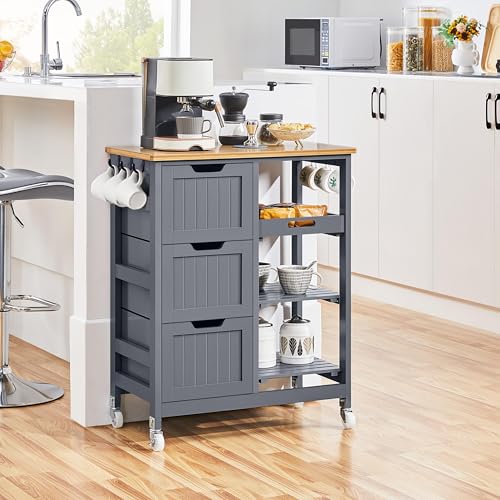
Yaheetech Kitchen Island Cart with 3 Drawers and 3 Shelves, Dark Gray — consider instead if…
…you want more drawers and a published countertop size for roughly a dozen dollars more. The Yaheetech Kitchen Island Cart with 3 Drawers and 3 Shelves, Dark Gray lists a 26.5″ L × 15″ W countertop, three drawers, three open shelves, and a 165 lb capacity, built from solid wood and CARB P2-compliant MDF. Its standout trick is a detachable tray with cut-out handles that lifts out of the shelving to serve as a breakfast tray.
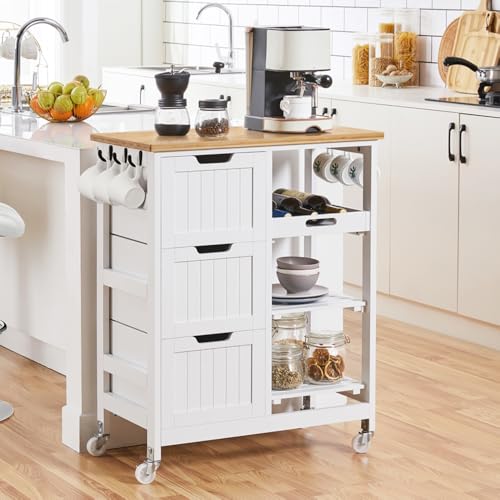
Yaheetech Kitchen Island Cart on Wheels with 3 Drawers and 3 Shelves, White — consider instead if…
…you need that same three-drawer layout in white, plus hooks. The Yaheetech Kitchen Island Cart on Wheels with 3 Drawers and 3 Shelves, White at $114.99 pairs three drawers, three open shelves, and six side hooks with the same 165 lb capacity, solid wood legs, detachable serving tray, and four universal wheels (two locking).
Yaheetech Rolling Kitchen Island Cart with Drop Leaf, Portable Rubberwood Breakfast Bar with Storage Cabinet, Open Shelves & Detachable Towel, 2 Drawers, Black — consider instead if…
…you actually want to eat at it. The Yaheetech Rolling Kitchen Island Cart with Drop Leaf, Portable Rubberwood Breakfast Bar with Storage Cabinet, Open Shelves & Detachable Towel, 2 Drawers, Black is counter height with a foldable drop-leaf countertop meant to pair with counter stools, and it rates 320 lb — more than double the base model. It adds two drawers, a towel bar, three open shelves, and a two-tier cabinet with a shelf adjustable to three heights.
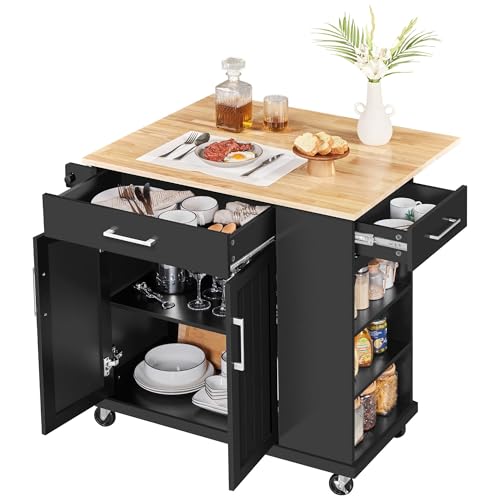
Yaheetech Rolling Kitchen Island Cart with 3 Drawers, Kitchen Storage Cabinet on Wheels with Open Shelves and Inner Adjustable Shelves for Dining Room/Living Room, Thicker Rubberwood Top, White — consider instead if…
…you've outgrown carts entirely. The Yaheetech Rolling Kitchen Island Cart with 3 Drawers, Kitchen Storage Cabinet on Wheels with Open Shelves and Inner Adjustable Shelves for Dining Room/Living Room, Thicker Rubberwood Top, White holds 507 lb total with a 176 lb countertop rating, hides its four casters for a built-in look, and adds soft-close door hinges plus beadboard panels. Three drawers, a double-door cabinet, and two side open-shelf cabinets.
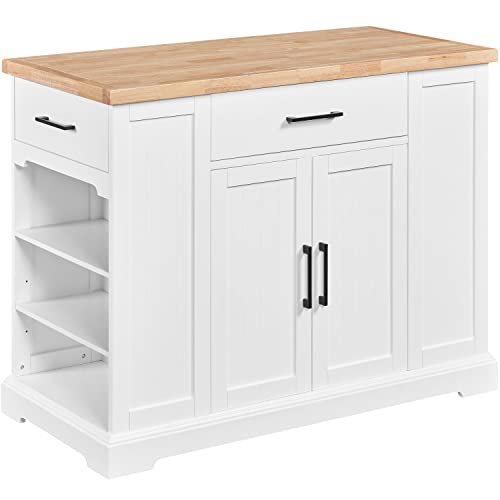
Yaheetech Kitchen Island on Hidden Wheels, Rolling Kitchen Cart with Thicker Rubberwood Top & 3 Drawers & Open Shelves, Storage Cabinet with Adjustable Shelves for Dining Room, 46″L × 22″W, Black — consider instead if…
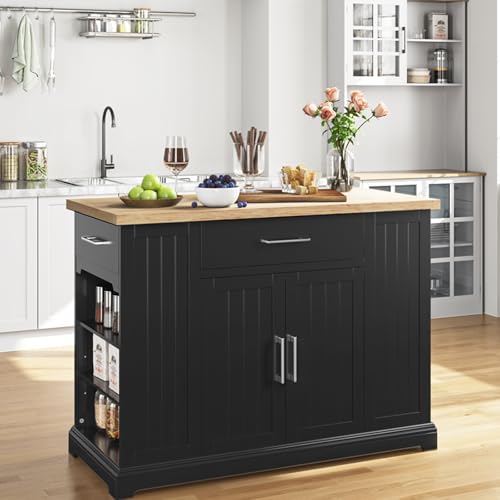
…you want that same heavy-duty build in black with the dimensions spelled out. The Yaheetech Kitchen Island on Hidden Wheels, Rolling Kitchen Cart with Thicker Rubberwood Top & 3 Drawers & Open Shelves, Storage Cabinet with Adjustable Shelves for Dining Room, 46″L × 22″W, Black gives you a 46″ × 22″ water-resistant rubberwood top, 507 lb total capacity, hidden swivel casters with brakes, and shelves adjustable at three heights in 2.5″ increments.
FAQ
Is 138 lb enough capacity for a microwave? For a standard countertop microwave, yes — but remember that 138 lb is the cart's total rating, covering the top and everything stored below. Budget the rest of your load accordingly.
Can I use it as a breakfast bar? Not this model. Yaheetech states you should not step or sit on it, and no counter height is listed. The drop-leaf model is the one explicitly described as counter height and designed to pair with stools.
Will it roll around while I'm working? Two of the four 360° swivel wheels lock, which is what holds it in place. All four wheels swivel, so with the brakes off it moves freely — engage the locks before you load it.
How big is the countertop? The product data doesn't state it. If exact dimensions matter, check the listing's images and detail table directly, or pick one of the models that publishes measurements — the dark gray three-drawer cart (26.5″ × 15″) or the black hidden-wheel island (46″ × 22″).
Related guides
- Privacy Policy
- Top 10 Tips for Best dining room furniture and tables - dining tables, dining chairs, bar stools, sideboards, kitchen islands, counter-height dining sets, china cabinets, bar carts, kitchen dining sets
- Best dining room furniture and tables - dining tables, dining chairs, bar stools, sideboards, kitchen islands, counter-height dining sets, china cabinets, bar carts, kitchen dining sets Requirements Explained
Key Takeaways
- Choosing the right yaheetech kitchen island cart review means matching the key features to your specific needs and budget
- Read real customer reviews and check the return policy before you commit
- Compare value across models — the priciest option is not always the best fit