Specifications
| Product | Width | Depth | Height | Storage layout | Finish | Price |
|---|---|---|---|---|---|---|
| HOSTACK 60" W Sideboard Buffet Cabinet with Storage, Kitchen Cabinet, Black | 60" | 15.75" | 36.02" | 4 concealed cupboards, each with easy-glide drawer; holds up to 450 lbs | Black, MDF | Check price on Amazon |
| IFGET 92.63" W Modern Arched Sideboard Buffet Cabinet with Storage, Natural | 92.63" | 15.75" | 34" | Three cabinets; adjustable shelf with 3 height settings; 5.7" base clearance | Natural | Check price on Amazon |
| IFGET 61.75" W Modern Arched Sideboard Buffet Cabinet with Storage, Natural | 61.75" | 15.75" | 34" | Two cabinets; adjustable shelf with 3 height settings; 5.7" base clearance | Natural | Check price on Amazon |
| BOTLOG 71" Large Buffet Cabinet with Storage | 71" | Not stated | Not stated | 8 compartments, 6 soft-close doors, 2 adjustable shelves (2.5" flexibility), 2 deep sliding drawers | Black | Check price on Amazon |
| Evermagin 67IN Oak Fluted Sideboard Buffet Cabinet with Storage | 67" | Not stated | Not stated | Not stated | Oak, fluted | Check price on Amazon |
| ONBRILL 48 Inch Buffet Cabinet with Storage | 48" | Not stated | Not stated | 2 drawers, 3 doors, adjustable shelves, 5 legs | Brown | Check price on Amazon |
Quick answer: Style a dining room sideboard in three layers — one tall anchor (art, mirror, or a pair of lamps) hung or placed so it fills roughly two-thirds of the cabinet's width, a mid-height cluster of two or three objects grouped in a triangle, and one low horizontal element like a tray or stack of books. Leave at least a third of the top surface completely empty so the piece can still do its actual job during dinner. If you're buying the cabinet first, width and top height matter far more than finish: a 60–72" cabinet with a 34–36" top gives you a serving surface that works standing up and still leaves room to decorate.
The three-layer method, in practice
Most sideboards look cluttered for one reason: everything on top is the same height. Fix that first.
Layer one — the anchor. Hang art or a mirror so its bottom edge sits 6–8 inches above the cabinet top, and size it to about two-thirds the cabinet's width. On a 92-inch cabinet that's a very large piece or a gallery grouping; on a 48-inch cabinet a single 30-inch frame reads correctly. If you don't want to put holes in the wall, a pair of table lamps does the same job and adds usable light for evening meals.
Finding the right how to style a sideboard in dining room comes down to matching the features to how you will actually use it.
Layer two — the mid cluster. Two or three objects of differing heights, grouped off-center rather than dead-center: a ceramic vessel, a small stack of books with an object on top, a plant. Odd numbers and a rough triangle shape.
Layer three — the horizontal. A tray, a runner, or a shallow bowl that visually connects the cluster to the surface and stops everything floating.
Then subtract. Clear one full section — usually the end nearest the kitchen — and keep it clear. That's where the platter goes on Thanksgiving. A sideboard that can't hold a serving dish isn't styled, it's decorated.
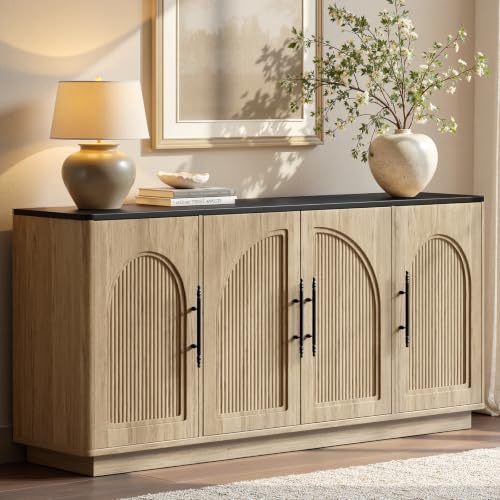
Fluted and arched fronts change the rules. If the doors already have carved detail, keep the top sparse — the cabinet is the pattern. Flat-panel black cabinets are the opposite: they read as a backdrop and can carry busier, brighter styling.
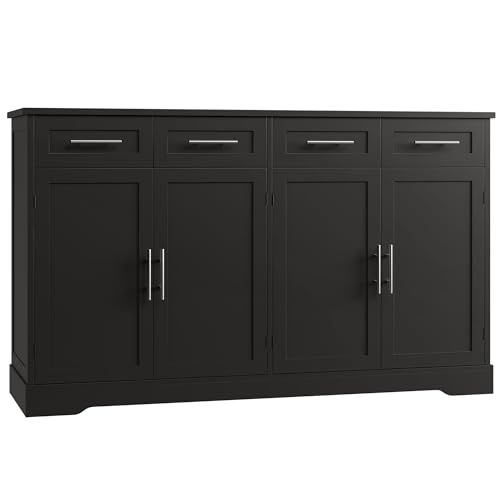
HOSTACK 60" W Sideboard Buffet Cabinet with Storage, Kitchen Cabinet, Black
The HOSTACK 60" W Sideboard Buffet Cabinet with Storage, Kitchen Cabinet, Black is the shape most dining rooms actually want. Sixty inches sits under the majority of standard dining table lengths without crowding a chair pulled out, 15.75 inches deep keeps it out of the walkway, and the 36.02" top height means you're serving at counter height rather than bending. The stated 450 lb load rating covers a stone lamp base, a full set of dishes on top, and a drinks setup at once. Four concealed cupboards each with a drawer means linens and flatware go in the drawers and the bulky serving pieces go behind doors — the split that keeps a dining room from turning into a junk drawer.
For styling, the inset paneling and black finish behave like a picture frame. Warm brass or wood-toned objects pop against it; a gilt mirror above it is nearly foolproof.
Who it's for
- Rooms with a 6–8 foot wall to fill, where a 60" cabinet leaves visual breathing room at both ends
- People who want to serve buffet-style standing up — the 36" top is the reason
- Anyone styling with a mirror or large art, since a dark flat front gives the wall piece somewhere to sit
- Households that need heavy-item storage: the 450 lb figure is stated in the product data
- Renters and movers who need something that assembles with numbered parts
Who should skip it
- Anyone with a wall shorter than about 66 inches — a 60" cabinet with no margin looks wedged in
- People who want a light, airy, natural-wood dining room; black is a commitment
- Anyone planning to keep tall bottles or a stand mixer on an interior shelf — shelf clearances aren't stated
- Robot vacuum households who need under-cabinet clearance, which isn't listed for this model
- Anyone who wants solid wood; the data says high-grade MDF
Honest trade-offs
MDF construction is normal at this price and it's genuinely stable, but it doesn't refinish and it doesn't love standing water — wipe spills rather than letting them sit, even with the stated liquid and stain resistance. "Concealed cupboard storage each with easy-glide drawer" tells you the layout but not the shelf heights, so if you have a specific tall item in mind, measure before committing. Soft-close hinges aren't mentioned for this model; if quiet doors matter to you, that's a real differentiator elsewhere in this list. And the 36.02" height that makes serving comfortable also raises your art 2 inches higher than a 34" cabinet would — plan the hang accordingly.
What to check on the listing before you buy
- Current price. All figures here are point-in-time and furniture pricing moves constantly.
- Variant. Several of these come in multiple widths and finishes on the same listing page — confirm the one in your cart is the size you measured for.
- Shipping split. The IFGET cabinets ship in multiple boxes that may arrive on different days, per the manufacturer.
- Warranty and return window. Large furniture returns are expensive and policies differ by seller; read them before, not after.
- Recent buyer reviews and Q&A. Go read them yourself, especially any questions about shelf clearance and packaging damage — that's where real dimension details usually surface.
- Anti-tip hardware. IFGET states anti-tip kits are included; if a model doesn't say so and you have kids, buy a strap separately.
Consider instead
IFGET 92.63" W Modern Arched Sideboard Buffet Cabinet with Storage, Natural — consider instead if…
You have a long, empty dining wall and want the cabinet to be the statement. The IFGET 92.63" W Modern Arched Sideboard Buffet Cabinet with Storage, Natural is three cabinets at 15.75"D x 92.63"W x 34"H with a shelf adjustable to three heights, 5.7" of base clearance for a robot vacuum, and included anti-tip kits. At nearly eight feet, style it in three distinct vignettes rather than one centered arrangement, and expect a two-person lift.
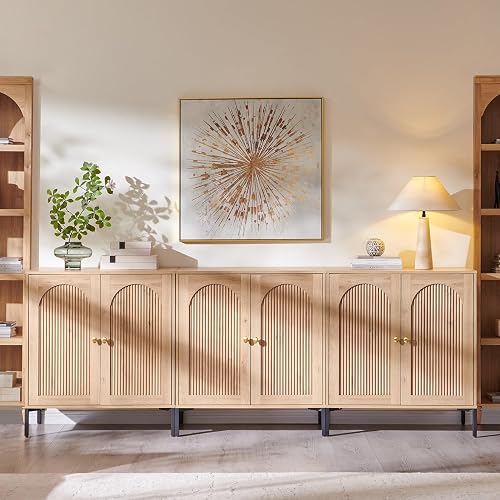
IFGET 61.75" W Modern Arched Sideboard Buffet Cabinet with Storage, Natural — consider instead if…
You want the arched fluted look in a normal-sized room. The IFGET 61.75" W Modern Arched Sideboard Buffet Cabinet with Storage, Natural is the two-cabinet version — 15.75"D x 61.75"W x 34"H, same three-position shelf, same 5.7" base clearance and anti-tip hardware. The 34" top is a couple of inches lower than counter height, which reads slightly more furniture-like and less kitchen-like.
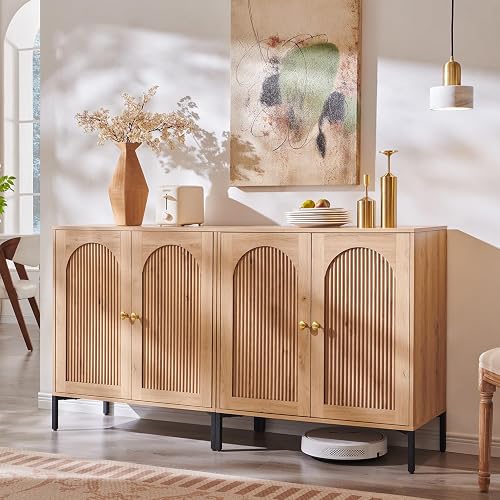
BOTLOG 71" Large Buffet Cabinet with Storage — consider instead if…
Storage is the actual problem and styling is secondary. The BOTLOG 71" Large Buffet Cabinet with Storage, Sideboard Buffet Cabinet with Adjustable Shelves and 6 Soft-Close Doors, Wood Coffee Bar Console Table for Kitchen, Dining Room, Black gives you 8 compartments, six soft-close doors, two adjustable shelves with 2.5" of flexibility, and two deep sliding drawers. It's the one on this list that explicitly names soft-close hinges — worth it if your dining room is next to a bedroom.
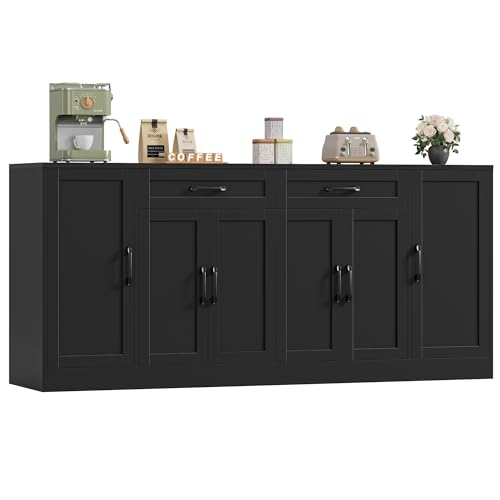
Evermagin 67IN Oak Fluted Sideboard Buffet Cabinet with Storage — consider instead if…
You want warm oak and arched detailing without going to a nine-foot cabinet. The Evermagin 67IN Oak Fluted Sideboard Buffet Cabinet with Storage uses a floating base and curved corners, which reads lighter in a small room and reduces sharp-edge bumps in a tight walkway. Depth and height aren't stated, so measure your clearance and confirm on the listing first.
ONBRILL 48 Inch Buffet Cabinet with Storage — consider instead if…
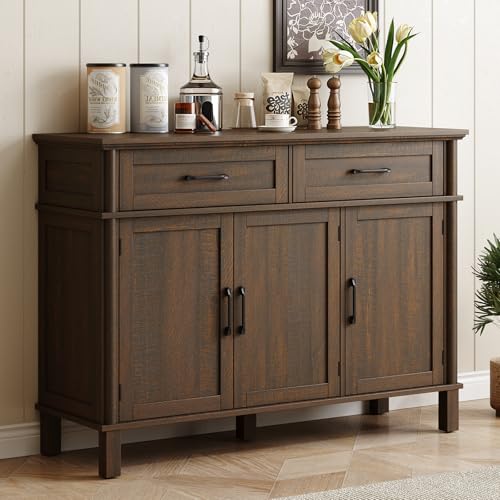
Your wall is short, or the sideboard is going in a living room or entryway rather than under a big dining wall. The ONBRILL 48 Inch Buffet Cabinet with Storage, Farmhouse Sideboard Buffet w/2 Drawers and 3 Doors, Wood Coffee Bar Cabinet with Adjustable Shelves, Sideboard Storage for Kitchen, Living Room, Brown is the compact, lowest-priced option here, with two drawers, three doors, adjustable shelves and five legs for support. At 48 inches, style it with two objects and one anchor — three vignettes will look crowded.
FAQ
How do I style a sideboard in a living room instead of a dining room? Same three layers, different contents. In a living room the sideboard usually becomes a bar or a media surface, so swap serving pieces for a tray of glassware or a lamp plus a small speaker. Because you sit near it rather than stand at it, lower cabinets around 34 inches — like both IFGET models — feel more proportional than counter-height ones.
How much empty space should I leave on top? Roughly a third, and it should be contiguous rather than scattered gaps. On a 60-inch top that's about 20 inches of clear surface, which is enough for a platter or a cutting board.
Should the sideboard match my dining table exactly? No — matched sets tend to flatten a room. Pick up one shared element instead: the same wood tone, the same metal on the hardware, or the same leg style. A black cabinet with a wood table works well precisely because the contrast is deliberate.
How wide should a sideboard be relative to my dining table? Aim for a cabinet that's shorter than the table, generally in the 48–72 inch range for a standard six-seat table, and leave at least 36 inches of walking clearance between the table edge and the cabinet front so chairs can pull out. A 15.75-inch depth, which several of these share, helps in tight rooms.
Related guides
- Best Options for Best dining room furniture and tables - dining tables, dining chairs, bar stools, sideboards, kitchen islands, counter-height dining sets, china cabinets, bar carts, kitchen dining sets
- Best dining room furniture and tables - dining tables, dining chairs, bar stools, sideboards, kitchen islands, counter-height dining sets, china cabinets, bar carts, kitchen dining sets with Past Challenges
- About Our Best dining room furniture and tables - dining tables, dining chairs, bar stools, sideboards, kitchen islands, counter-height dining sets, china cabinets, bar carts, kitchen dining sets Process
Key Takeaways
- Choosing the right how to style a sideboard in dining room means matching the key features to your specific needs and budget
- Read real customer reviews and check the return policy before you commit
- Compare value across models — the priciest option is not always the best fit