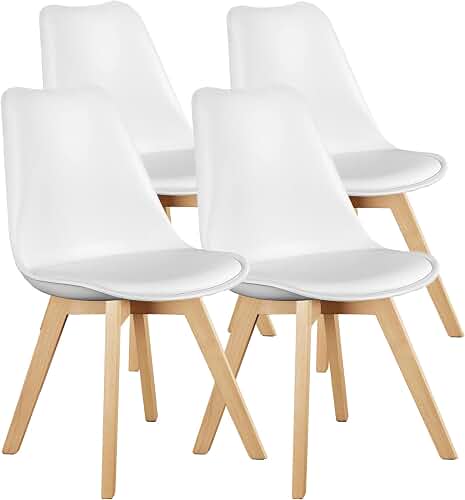
Specification comparison
| Product | Price | Set size | Frame / legs | Weight capacity | Upholstery | Dimensions |
|---|---|---|---|---|---|---|
| OLIXIS Dining Chairs Set of 4, PU Leather Accent Chairs for Living Room | Check price on Amazon | 4 | Beech wood legs, 2.5cm diameter | 275 lbs | PU leather, waterproof | 22.83"W x 20.47"D x 32.87"H |
| COLAMY Wooden Dining Chairs Set of 4 | Check price on Amazon | 4 | Wood legs with foot pegs | 250 lbs | Fabric | 19" height (as stated) |
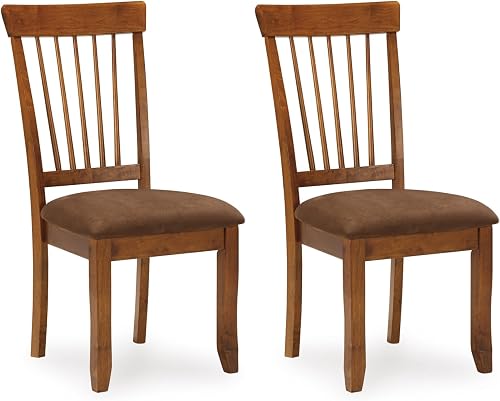
| Signature Design by Ashley Berringer Spindle Back | Check price on Amazon | 2 | Wood | Not stated | Microfiber | 19"W x 22.75"D x 38.25"H |
| DUMOS Dining Chairs Set of 2, Mid Century Modern | Check price on Amazon | 2 | Black metal, reinforced inner wall | 275 lbs | Boucle fabric, 3.94" cushion | Not stated |
| VASAGLE Dining Chairs, Set of 4 | Check price on Amazon | 4 | Metal, adjustable feet | 265 lbs | Chenille front / synthetic leather back | Not stated |
| DUMOS Dining Chairs Set of 4, Linen Fabric | Check price on Amazon | 4 | Wood-grain metal legs | Not stated | Linen fabric, memory foam | Not stated |
Quick answer: The three specs that decide whether a dining chair works are seat height (17–19" for a standard 30" table), overall width (so chairs don't collide when pushed in), and upholstery you can actually wipe down. Everything else — spindle back vs. curved back, wood legs vs. metal — is taste. If you're buying for a busy household or a commercial-style setting, prioritize stated weight capacity and cleanable surfaces over looks.
Note how many cells say "Not stated." That's normal and it's the first thing to fix on the listing page itself — see below.
Who dining chairs like these are for
You're the right buyer if you have a standard-height dining table (roughly 28–30" from floor to tabletop) and you want side chairs — no arms — that tuck in. Every chair here is a side chair, which is why the COLAMY set specifically advertises that the chairs push in under the table to save space. Armless is the default for a reason: arms add 4–6" of width per chair and frequently won't clear an apron-style table edge.
The best dining chair buying guide for your situation depends on how you plan to use it and where.
You're also the right buyer if you're replacing chairs rather than buying a whole set. The Signature Design by Ashley Berringer Spindle Back set ships as a set of 2 and is explicitly described as pairing with existing dining chairs, which is the use case for adding two head-of-table chairs to a four-chair set you already own.
And if the room does double duty — home office, homework table, occasional laptop desk — look hard at back angle. The VASAGLE set states a 105° inclined backrest; the OLIXIS set states a 10-degree backward tilt. A reclined back is more comfortable for sitting an hour past dinner and slightly worse for eating upright.
Who should skip this category
Skip if you actually need commercial-grade seating. People searching for restaurant chairs land on guides like this one and it's worth being blunt: nothing here is sold as a commercial product. Restaurant seating is typically rated for continuous multi-user cycling, sometimes carries a BIFMA or commercial-use rating, and comes with a contract warranty. None of the products listed here state a commercial rating. The COLAMY listing mentions restaurants and cafes among its suggested settings, but a marketing suggestion is not a commercial certification. If you're seating paying customers eight hours a day, buy from a hospitality supplier.
Skip if you have a counter-height or bar-height table. These are all standard dining-height chairs. A 24" counter needs a 24–26" stool; a 42" bar needs a 29–30" stool. Buying a dining chair for a counter is the single most common return in this category.
Skip if you need chairs today and can't assemble. Every product here ships flat-packed and requires assembly. OLIXIS states about 20 minutes; VASAGLE states 5 minutes per chair. Those are vendor claims, not guarantees, but the point stands — a screwdriver is involved.
The honest trade-offs
Cleanability vs. comfort. PU and synthetic leather wipe clean; woven fabric does not. The OLIXIS set is described as waterproof and easy to clean, and VASAGLE puts water-resistant synthetic leather on the backrest specifically because that's the part hands touch. But leather-look surfaces get sticky in summer and cold in winter. Boucle and linen — the DUMOS sets — feel better and absorb everything. If you have kids under ten, this decision is already made for you.
Price per chair vs. set size. Compare per-seat, not per-box. DUMOS Dining Chairs Set of 2 at $77.96 works out to about $39 a seat; DUMOS Dining Chairs Set of 4, Linen Fabric at $179.99 is about $45 a seat; COLAMY at $279.98 for four is about $70 a seat. The cheap-per-seat options are cheap because of thinner frames and simpler joinery, not because someone made a pricing error.
Weight capacity is a real spec, not a formality. Two chairs here state 275 lbs, one states 265 lbs, one states 250 lbs, and two don't state a figure at all. A 25-pound spread matters less than whether the number exists. An unstated capacity means the manufacturer didn't test it or didn't want to publish it.
Wood legs vs. metal legs. Wood (OLIXIS uses beech; COLAMY uses wood with foot pegs) looks warmer and is repairable — you can re-glue a loose joint. Metal (DUMOS, VASAGLE) is generally more rigid and often gets you adjustable feet, which the VASAGLE and DUMOS 4-pack both include for uneven floors. Wood legs on an uneven floor need felt shims and patience.
What to check on the listing before you buy
Listings change constantly. Prices in this guide are what was recorded at the time of writing, not what you'll pay.
- Confirm the current price and the set size in the same breath. Several of these sell as both 2-packs and 4-packs. The price you see may be attached to a different quantity than the one shown in the photo.
- Check the variant you're selecting. COLAMY lists Beige; DUMOS Set of 2 lists Green; VASAGLE lists Cream White. Color variants often carry different prices and, occasionally, different stock and shipping timelines.
- Find the seat height. It's frequently buried in the A+ content rather than the bullet list. Ashley's Berringer listing gives an 18" seat height in its title and overall dimensions of 19"W x 22.75"D x 38.25"H — that's the level of detail you want before committing.
- Measure the width against your table. Take your table length, divide by the chair width, and leave 6" of clearance between chairs. The OLIXIS chairs at 22.83" wide need a 60"+ table to seat four comfortably along the sides.
- Read the warranty terms and the return window on the actual product page. Furniture returns often have different rules than the general policy.
- Go read recent reviews yourself, sorted by most recent and filtered to your variant. Don't take anyone's summary of them, including mine.
Consider instead if…
OLIXIS Dining Chairs Set of 4, PU Leather Accent Chairs for Living Room — consider instead if…
…you want the lowest cost per seat with a wipeable surface. At $89.99 for four, OLIXIS Dining Chairs Set of 4, PU Leather Accent Chairs for Living Room combines beech wood legs, a stated 275 lb capacity, and PU upholstery described as scratch-resistant and waterproof. The 22.83" width is generous, so measure your table run first.
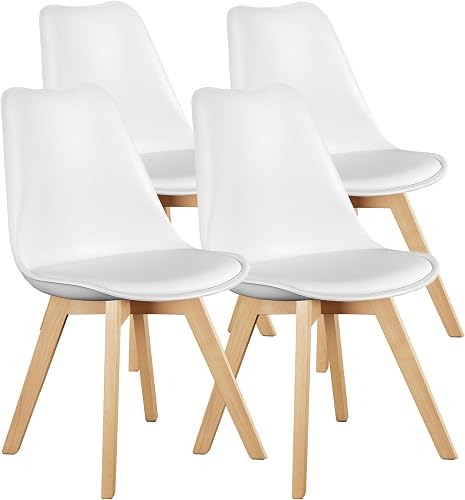
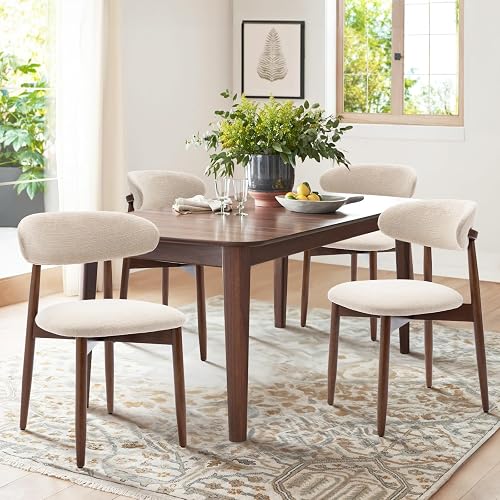
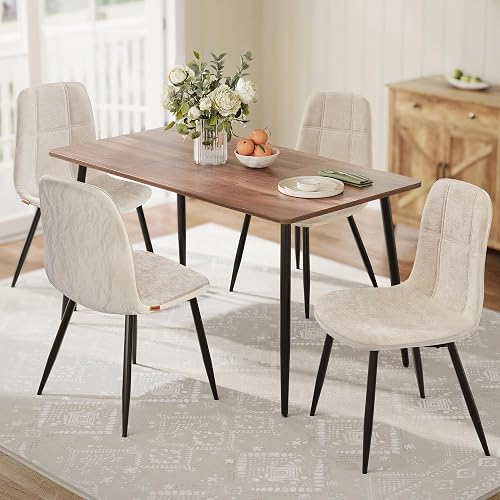
COLAMY Wooden Dining Chairs Set of 4, Modern Fabric Upholstered Kitchen Side Chairs, Farmhouse Dining Room Chair with Foot Pegs, Beige — consider instead if…
…you want a warmer farmhouse look and are willing to pay for it. COLAMY Wooden Dining Chairs Set of 4, Modern Fabric Upholstered Kitchen Side Chairs, Farmhouse Dining Room Chair with Foot Pegs, Beige is the priciest here at $279.98 and states a 250 lb capacity — the lowest stated figure in this group — so it's a style-led choice, not a durability-led one.
Signature Design by Ashley Berringer | Spindle Back 18" Dining Chairs (Set of 2) – Rustic Light Brown with Upholstered Cushioned Seat — consider instead if…
…you need exactly two chairs to fill out an existing set. Signature Design by Ashley Berringer | Spindle Back 18" Dining Chairs (Set of 2) – Rustic Light Brown with Upholstered Cushioned Seat publishes full dimensions (19"W x 22.75"D x 38.25"H) and uses easy-care microfiber over a wood spindle-back frame. No weight capacity is stated.
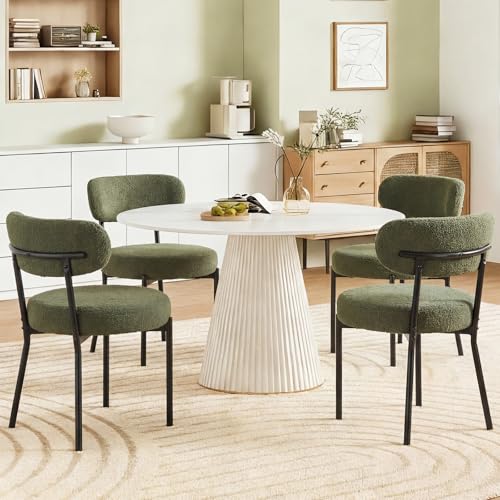
DUMOS Dining Chairs Set of 2, Mid Century Modern Chair Round Upholstered Curved Backrest, Kitchen Vanity Living Room Chairs with Black Metal Legs, Green — consider instead if…
…you want the softest seat in the group. DUMOS Dining Chairs Set of 2, Mid Century Modern Chair Round Upholstered Curved Backrest, Kitchen Vanity Living Room Chairs with Black Metal Legs, Green states a 3.94" high-density foam cushion, a 275 lb metal frame, and swivel foot pads for uneven floors — at $77.96 for two.
VASAGLE Dining Chairs, Set of 4 Dining Room Chairs, Metal Frame, Adjustable Feet, Easy to Clean, Chenille Fabric, Glacier-Textured Synthetic Leather, for Kitchen, Cream White UKDC188W01 — consider instead if…
…you want fabric comfort where you sit and wipeable material where you don't. VASAGLE Dining Chairs, Set of 4 Dining Room Chairs, Metal Frame, Adjustable Feet, Easy to Clean, Chenille Fabric, Glacier-Textured Synthetic Leather, for Kitchen, Cream White UKDC188W01 pairs a chenille front with a water-resistant synthetic leather back, a 105° backrest, 265 lb capacity, and adjustable feet, at $119.98 for four.
DUMOS Dining Chairs Set of 4, Linen Fabric Accent Chair with Curved Back — consider instead if…
…you want lumbar support for long meals. DUMOS Dining Chairs Set of 4, Linen Fabric Accent Chair with Curved Back uses high-density plus memory foam behind an ergonomic curved backrest, with wood-grain metal legs and adjustable anti-slip foot pads, at $179.99 for four. Weight capacity isn't stated.
FAQ
What seat height do I need? For a standard 30" table, aim for a 17–19" seat height, which leaves 11–13" of thigh clearance. The Ashley Berringer set states an 18" seat height, which sits squarely in that range. Measure from your floor to the underside of the table apron — not the tabletop — before you buy.
Can I use these chairs in a restaurant or café? None of these products state a commercial-use rating, so treat them as residential furniture. Home-grade joinery under continuous daily commercial cycling fails faster than the stated weight capacity suggests. For paying customers, buy contract-grade seating with a commercial warranty.
Fabric or faux leather for a house with kids? Faux leather or synthetic leather wipes clean, which is why OLIXIS and VASAGLE both highlight water resistance. Woven fabric like boucle and linen feels nicer but absorbs spills. If you love a fabric chair anyway, budget for a fabric protector spray and check whether covers are removable before ordering.
Do I need to worry about how much assembly is involved? All of these ship flat and need assembly, with vendor-stated times ranging from about 5 minutes per chair (VASAGLE) to about 20 minutes (OLIXIS). Multiply by the number of chairs. Confirm that hardware and tools are included on the current listing, since packaging contents change between production runs.
Related guides
- Best dining room furniture and tables - dining tables, dining chairs, bar stools, sideboards, kitchen islands, counter-height dining sets, china cabinets, bar carts, kitchen dining sets for Small Business Owners
- FAQ: Best dining room furniture and tables - dining tables, dining chairs, bar stools, sideboards, kitchen islands, counter-height dining sets, china cabinets, bar carts, kitchen dining sets
- Alternative Options for Best dining room furniture and tables - dining tables, dining chairs, bar stools, sideboards, kitchen islands, counter-height dining sets, china cabinets, bar carts, kitchen dining sets
Key Takeaways
- Choosing the right dining chair buying guide means matching the key features to your specific needs and budget
- Read real customer reviews and check the return policy before you commit
- Compare value across models — the priciest option is not always the best fit